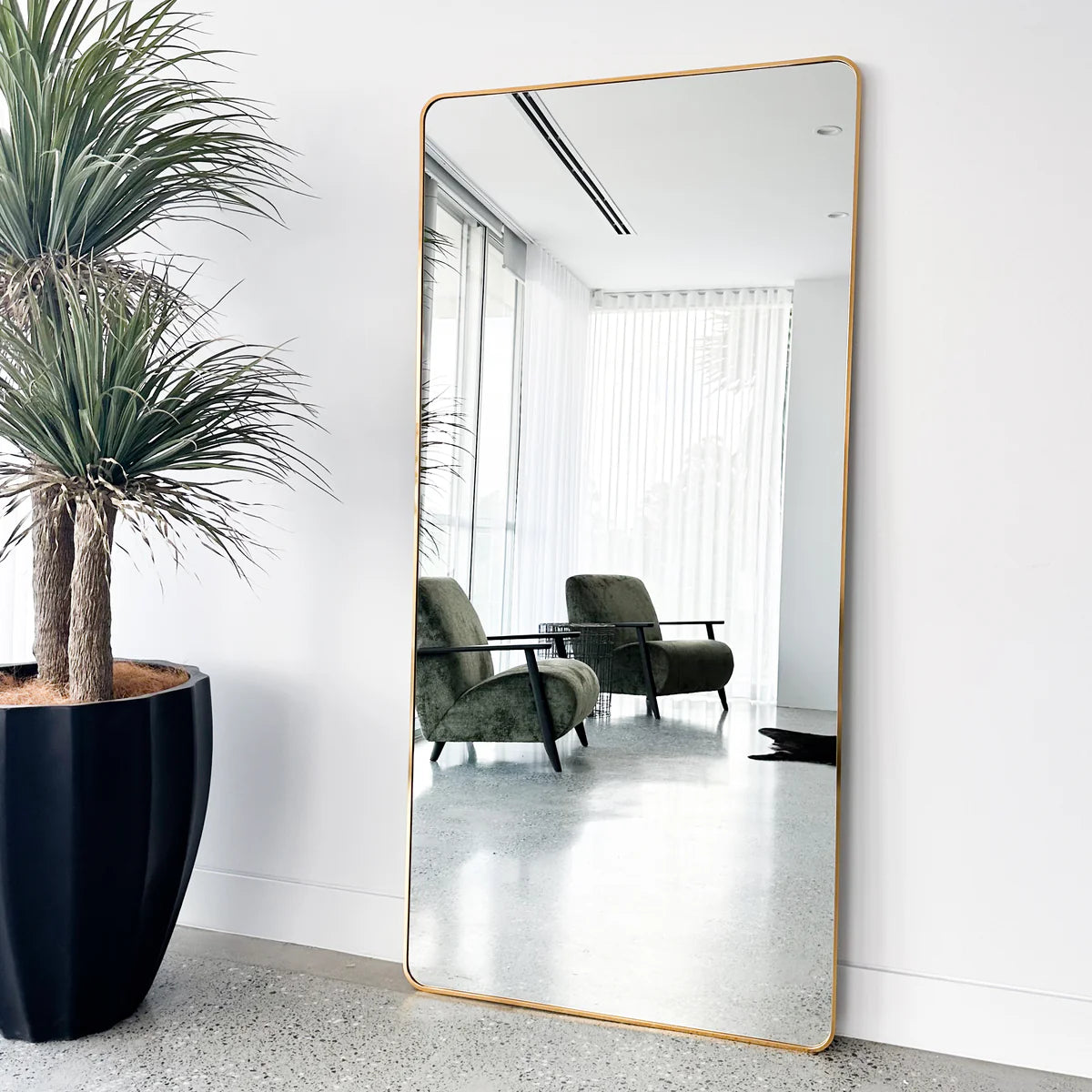
A floor mirror can do much more than provide a full-body reflection. The right design can introduce height, reflect natural light, create greater visual depth and become a statement piece within a bedroom or living space.
But should you choose a large or narrow floor mirror? Is it better to lean it or mount it? And where should you position a floor mirror so it actually improves the room?
This guide covers the practical and interior-design considerations to think about before buying. You can also explore our complete collection of Floor Mirrors to compare different sizes, shapes and finishes.
What Is a Floor Mirror?
A floor mirror is generally a larger mirror designed to sit at or close to floor level. Many are tall enough to provide a full-body reflection, which is why the terms floor mirror, full length mirror and standing mirror are often used interchangeably.
The difference usually comes down to how the mirror is positioned.
A floor mirror may lean against a wall, be mounted vertically from close to floor level or, in some designs, stand independently.
Because they're typically larger than standard wall mirrors, floor mirrors also have enough visual scale to become part of the furniture arrangement within a room.
Why Choose a Floor Mirror?
The biggest advantage of a floor mirror is the combination of function and scale.
You get a practical mirror for getting dressed while introducing a large reflective surface into the room.
That larger surface can reflect more of your interior, which creates a greater sense of depth. When positioned around natural light, it can also reflect brighter parts of the room.
A large floor mirror can therefore work particularly well when you have an empty wall that feels unfinished but don't necessarily want to fill it with artwork or additional furniture.
What Size Floor Mirror Should I Choose?
Start with the wall rather than the mirror.
Measure the available height and width, then consider how much empty space you want to leave around the mirror.
Small & Narrow Floor Mirrors
A narrower floor mirror works well in apartments, smaller bedrooms and spaces between wardrobes or furniture.
Widths around 50–70cm can provide a practical full-body reflection without requiring a large section of wall.
The Bella Minimal Floor Mirror is an example of the cleaner rectangular approach to a floor mirror.
Large Floor Mirrors
Once you move into mirrors around 80–100cm wide, they begin to have considerably more visual presence.
These sizes work particularly well in bedrooms and living rooms where you want the mirror to become part of the interior rather than simply serve a practical purpose.
Extra Large Floor Mirrors
Oversized designs around 200cm tall and above can become defining features of a room.
They're particularly effective with high ceilings, large blank walls and open-plan interiors where a smaller mirror may look visually lost.
However, bigger isn't automatically better. An oversized floor mirror should look intentionally large rather than squeezed into the available space.
Does a Large Floor Mirror Make a Room Look Bigger?
It can make the room feel larger.
A mirror creates visual depth because you're seeing a reflected continuation of the surrounding space. The larger the reflective surface, the more of the room it can capture.
This can be particularly useful in smaller bedrooms, apartments and living rooms.
Position also matters.
A floor mirror facing an open part of the room generally creates a stronger sense of depth than one facing a nearby blank wall.
Where Should You Put a Floor Mirror?
Before choosing a position, ask two questions:
Will I actually be able to use the mirror here?
And:
What will the mirror reflect?
The second question is particularly important when styling large mirrors.
Floor Mirrors in Bedrooms
Bedrooms are one of the most practical places for a floor mirror.
Position your mirror near a wardrobe or dressing area with enough space in front of it to comfortably step backwards.
If possible, place it where it reflects natural light, an open section of the bedroom or another visually appealing area.
Avoid positioning a large mirror somewhere that primarily reflects clutter, open storage or a television.
Floor Mirrors in Living Rooms
In a living room, a floor mirror can function more like an interior feature.
A large leaning mirror can fill an otherwise empty wall without adding the visual weight of another piece of furniture.
Consider styling it near an occasional chair, console, side table or indoor greenery so the mirror feels integrated into the furniture arrangement rather than placed randomly against the wall.
Should a Floor Mirror Face a Window?
It can, and this is often an effective position.
A floor mirror can't create additional natural light, but it can reflect the light already entering the room.
Positioning a large mirror opposite or adjacent to a window can reflect a brighter part of the room and help distribute that light visually.
You should still consider the actual reflection. The best position is usually one that captures both light and an attractive view of the room.
Should You Lean or Hang a Floor Mirror?
This is one of the biggest decisions when styling a floor mirror.
Both approaches work, but they create very different results.
Leaning Floor Mirrors
A leaning floor mirror creates a relaxed, contemporary appearance.
It's particularly effective with oversized mirrors because the mirror begins to feel more like a piece of furniture.
Leaning also means you don't necessarily need the mirror to perfectly align with other wall-mounted elements in the room.
The angle is important. A mirror leaning too far backwards can distort the viewing angle, so keeping it relatively upright generally works better for everyday use.
Large leaning mirrors should also be appropriately secured to reduce the risk of tipping.
Wall-Mounted Floor Mirrors
Mounting a large mirror vertically creates a cleaner and more architectural appearance.
It keeps the floor immediately underneath the mirror clear and can be preferable in narrow rooms or areas with more foot traffic.
A vertically mounted mirror also provides a more straightforward viewing angle when you're using it to check your outfit.
Always check the installation requirements for the specific mirror you purchase.
What Shape Floor Mirror Should You Choose?
Shape changes the personality of a floor mirror considerably.
Arch Floor Mirrors
An arch introduces a curved architectural element while retaining the practical proportions of a traditional full length mirror.
This works particularly well in rooms dominated by straight lines from doors, wardrobes, beds and cabinetry.
The Eve Full Length Arch Mirror is an example of a larger arch design that can be styled at floor level.
Rectangle Floor Mirrors
Rectangle floor mirrors are the most structured option.
Their straight edges work naturally with minimalist and contemporary interiors and can align visually with surrounding furniture and architecture.
Irregular Floor Mirrors
An irregular or organic floor mirror makes the shape itself much more noticeable.
These designs can behave more like functional artwork and are particularly effective when you want the mirror to become a distinctive feature of the room.
Rounded Floor Mirrors
Pill-shaped and softly rounded mirrors sit somewhere between rectangles and arches.
They maintain symmetry while removing hard corners, making them useful when you want something softer without committing to a traditional arch.
Black, Gold, Silver or Wood Floor Mirror?
Frame finish can completely change how strongly the mirror stands out within the room.
Black Floor Mirrors
Black creates a defined outline around the mirror.
It works particularly well against white, cream and neutral walls and can connect with black window frames, lighting, furniture legs or other dark details.
Gold Floor Mirrors
Brushed gold introduces warmth.
It pairs naturally with beige, cream, warm whites, travertine, natural timber and warmer textiles.
A slim gold frame can introduce warmth without making the mirror feel overly decorative.
Silver Floor Mirrors
Silver is generally more understated.
The frame sits closer visually to the reflective glass itself, making it useful when you want the size and shape of the mirror to remain the main feature.
Wood Floor Mirrors
Wood introduces warmth and natural texture.
Timber floor mirrors work particularly well alongside linen, neutral upholstery, natural stone and other organic materials.
Can You Put a Big Floor Mirror in a Small Room?
Yes — and sometimes a larger mirror works better than several smaller decorative pieces.
A large reflective surface can create depth without physically occupying much usable floor space.
The key is choosing a relatively simple design and avoiding overcrowding the wall around it.
A slim-framed or frameless floor mirror can provide substantial scale while remaining visually lighter than a heavily decorated mirror.
What Should You Put Next to a Floor Mirror?
You don't necessarily need anything.
Leaving negative space around a large floor mirror can make the design feel more intentional and allows its shape to remain visible.
If you do want to style around it, consider a lounge chair, indoor plant, small side table or low console.
Try to avoid filling every available gap around the mirror. With larger floor mirrors, the scale of the mirror itself often provides enough visual interest.
Should a Floor Mirror Match Your Furniture?
It doesn't need to match exactly.
Instead, look for subtle connections between finishes.
A black mirror might repeat a black light fitting or furniture leg. A wood mirror can reference similar timber tones elsewhere in the room. A brushed gold frame might connect with handles or smaller metallic details.
You can also use contrast deliberately.
For example, an arched floor mirror can soften rectangular furniture, while an irregular mirror can introduce movement into an otherwise symmetrical room.
Floor Mirror vs Full Length Mirror: What's the Difference?
There's significant overlap between the two terms.
A full length mirror describes what the mirror does: it provides a head-to-toe reflection.
A floor mirror generally describes its scale and how it's positioned within the room.
Many designs are therefore both floor mirrors and full length mirrors.
If you're shopping specifically for a mirror to sit or lean at floor level, browse our Floor Mirrors and check the individual product specifications for mounting and styling options.
Floor Mirror vs Standing Mirror
The term standing mirror is often used when searching for a tall mirror positioned on the floor, but technically a freestanding mirror needs its own support or stand.
Not every floor mirror can stand independently.
Many large floor mirrors are instead designed to lean against a wall or be wall mounted.
If you specifically want a mirror that stands without wall support, check the individual product specifications before purchasing.
What Floor Mirror Works Best With Your Interior Style?
Minimal Interiors
Look for slim frames, simple rectangles, arches or frameless designs.
Black and silver work particularly well when you want to maintain clean architectural lines.
Warm Contemporary Interiors
Consider brushed gold or timber paired with warm whites, beige, linen, stone and natural materials.
Coastal Interiors
Wood, silver and lighter finishes work naturally alongside soft neutrals, textured fabrics and natural timber.
Statement Interiors
Consider oversized arches or irregular shapes where the mirror itself becomes one of the defining pieces within the room.
How to Choose the Right Floor Mirror
Start with how you'll use it.
If it's primarily for getting dressed, make sure you have enough space to stand back and see your full reflection.
If it's primarily an interior feature, consider the scale of the surrounding wall and furniture.
Then choose your shape. Arch mirrors soften straight lines, rectangles create cleaner geometry and irregular mirrors introduce a more artistic element.
Finally, consider what the mirror will reflect.
A well-positioned floor mirror can capture natural light, greenery or an open part of the room and make the entire space feel more considered.
Explore our Floor Mirrors to compare different sizes, shapes, finishes and designs.